
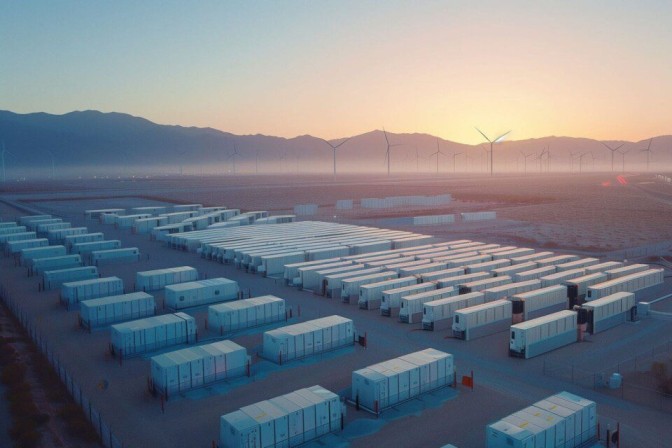
Romanian BESS projects become financeable only when grid constraints, market participation and contract structure line up in one coherent diligence file.
Everyone talks about BESS in Romania. Fewer projects actually reach a bankable stage. This note looks at where standalone and co-located storage really stand in 2025, how regulation interacts with grid constraints, and.
Everyone talks about BESS in Romania. Fewer projects actually reach a bankable stage. This note looks at where standalone and co-located storage really stand in 2025, how regulation interacts with grid constraints, and what investors check before committing capital.
Storage is no longer an "add-on" slide in a pitch deck, but a separate asset class with its own risks, contracts and regulatory questions.Storage has moved from buzzword to business case in Romania. Developers are testing standalone battery projects, banks are slowly building internal comfort, and regulators are under pressure to translate European targets into practical rules. At the same time, many projects still live mostly in Excel: technically interesting, but not yet positioned for investment or financing.
In practice, battery energy storage systems ("BESS") sit at the intersection of three realities:grid constraints,regulationandcontractual structure. How these are handled - not in theory, but in documents - is what determines whether a project is bankable in 2025.
1. Why BESS matters now in the Romanian context
Romania's renewable pipeline has grown quickly, with large volumes of solar and wind competing for limited grid capacity. This amplifies volatility on the balancing markets and exposes both TSOs/DSOs and producers to congestion and curtailment risk. BESS is relevant because it can:
- absorb surplus generation in congested nodes and release energy in more valuable hours;
- provide balancing and ancillary services needed for a system with high renewable penetration;
- support grid stability in areas where traditional reinforcements are slow or capital-intensive.
But these intuitive benefits do not automatically translate into a bankable business model. Revenue sources, regulatory treatment and technical integration must be sufficiently clear for investors and lenders that are fundamentally risk-averse.
2. Standalone vs. co-located BESS: two different stories
From a legal and commercial perspective, it is useful to distinguish betweenstandalone BESSandco-located BESS(storage built next to a PV or wind plant and sharing some infrastructure).
Standalone BESS
Standalone storage is often developed close to substations or nodes where congestion or flexibility needs are more visible. The project's value is not tied to a single generation asset, but to its ability to interact with markets (arbitrage, balancing, ancillary services) and grid constraints.
Legally, standalone BESS raises questions such as licensing status, grid connection conditions, tariff treatment and eligibility for potential support schemes or capacity mechanisms. Contractually, the focus is on how the project company will access those markets and who is responsible for forecasting, bidding and performance.
Co-located BESS
Co-located storage is often presented as a natural add-on to PV or wind projects. In practice, many development files show a PV plant that is relatively well documented, with storage appearing later as a potential option.
For investors, a "co-located" BESS which is not reflected in land rights, permits, grid documentation and contracts is not really a co-located project - it is simply a concept.
To be credible, the storage component should be integrated in land use rights, environmental assessments (where required), grid applications and key project contracts. Otherwise, the storage narrative adds complexity to due diligence without providing tangible value.
3. The revenue stack: what investors actually expect to see
Investors do not expect perfect certainty - BESS is, by nature, more exposed to merchant dynamics than a classic feed-in or long-term PPA model. However, they do expect to see a coherentrevenue stackand a credible story about how it will be accessed.
Typical revenue components
- Energy arbitrage- charging in low-price hours and discharging in higher-price periods, subject to spreads that are inherently uncertain.
- Balancing and ancillary services- participation in markets where technical requirements, prequalification procedures and contractual terms can be complex.
- Congestion management / grid-related services- where TSOs or DSOs may procure flexibility or capacity in specific locations.
- Potential support mechanisms- capacity remuneration or targeted schemes, where and when they become available.
A serious project will not simply list these components. It will explain which ones are realistically in scope for the specific asset, in light of its location, technical profile and the current regulatory framework. Financial models should distinguish clearly between "base case", "upside" and "optionality".
4. Regulatory and contractual points that change bankability
The regulatory framework for storage is still evolving, influenced by European rules on renewable integration, flexibility and capacity adequacy. From a project perspective, the key is not to wait for perfect regulation, but to understand how current rules impact:
- licensing and authorisation requirements for BESS;
- treatment of BESS in grid codes, connection procedures and technical approvals;
- access to markets (including prequalification) and any restrictions on participation;
- tariff treatment and potential double-charging of network fees if not properly addressed.
On the contractual side, investors look for clarity on who does what:
- which party is responsible for bidding and dispatch decisions;
- how performance is measured and shared between the asset owner and any optimisation or trading partner;
- how imbalance risk, penalties and underperformance are allocated;
- what happens if regulatory changes affect revenue streams (change-in-law mechanics).
"A storage project is not only a technical asset; it is a bundle of permissions, contracts and risk allocations. Bankability lives or dies in those details, not in high-level narratives."
5. Integration with PV and wind portfolios: risk or opportunity?
For portfolio investors, one key question is whether storage will be treated as:
- a separate asset class with its own SPVs, contracts and financing, or
- an integrated component of a broader renewables platform.
Each approach has consequences. Standalone BESS SPVs can be easier to understand from a risk perspective, but may depend heavily on market access arrangements. Integrated structures may capture synergies with PV and wind assets (e.g. connection sharing, joint balancing strategies), but require more careful drafting to align rights and obligations across the portfolio.
In either case, investors will test:
- whether storage is genuinely supported by permits, land and grid documentation;
- how the presence of BESS affects curtailment risk and connection conditions in practice;
- whether financing structures recognise the different risk profile of storage versus generation.
6. Practical checklist for developers and investors in 2025
For developers, the question is how to move BESS from "interesting slide" to "bankable asset". For investors, the question is how to filter projects quickly without rejecting opportunities that are genuinely robust. A practical checklist helps both sides.
For developers
- Make sure storage is reflected clearly in land rights, permitting strategy and grid documentation, not just in commercial narratives.
- Document the intended revenue stack in a realistic way, with transparent assumptions and scenario analysis.
- Align EPC, O&M, optimisation and trading arrangements with the technical and commercial profile you are presenting to investors.
- Build a clear change-in-law and regulatory monitoring approach into your contracts and model.
For investors
- Ask early whether the storage component is fully integrated into the project's legal and technical documentation.
- Separate "core" revenues from more speculative components and test sensitivities accordingly.
- Focus due diligence on grid conditions, market access and contractual allocation of imbalance and performance risk.
- Treat BESS as an asset with its own risk-return profile - related to, but not identical with, PV or wind.
As the regulatory framework continues to evolve, storage will likely play a larger role in how Romanian projects are structured, financed and valued. The projects that move first from concept to bankable documentation will have a clear advantage when capital becomes more selective.
If you are exploring a BESS project in Romania - standalone or co-located - and wish to test how it stands from a regulatory and transaction-readiness perspective, we can review the current documentation and provide a structured view on next steps.