
Site and constraint review
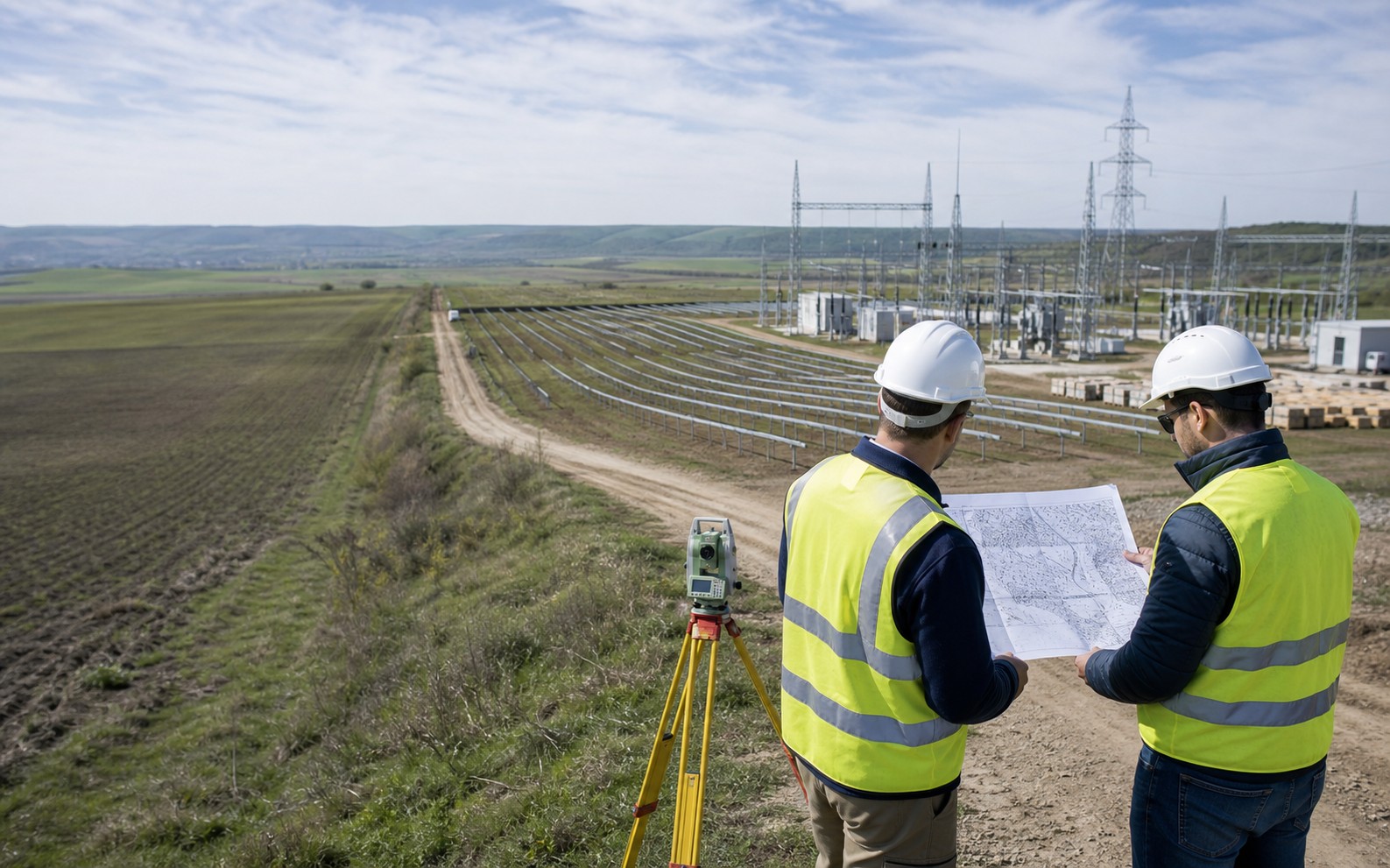
Topography, geotechnical, access, drainage, environmental and constructability constraints.

Development & bankability
We help renewable developers and investors define, challenge and document the technical basis of Romanian solar, wind and BESS projects. The work connects site constraints, grid assumptions, technology, yield, capex and programme so development claims can withstand investor and lender scrutiny.
Project stage is tested against evidence rather than labels.
Yield, capex, grid and schedule inputs are challenged together.
Gaps receive owners, dependencies, deadlines and decision consequences.
Where we fit
Development advisory is most valuable before design choices and project claims become expensive to reverse. It does not certify legal RTB status; Energy Law separately verifies land, permits, ATR, ANRE and contract rights.
What we do
We test the technical evidence that changes project maturity, value, bankability, programme, performance or acceptance.
Topography, geotechnical, access, drainage, environmental and constructability constraints.
Technology selection, layout, sizing, losses, interfaces and design criteria.
Resource data, methodology, losses, uncertainty and consistency with design.
Studies, export/import profile, reinforcements, protection and programme dependencies.
How we help
The output is designed for investors, lenders, owners and management teams: material risks, decision gates, accountable actions and evidence still required.
Define claimed stage, decision date and evidence available.
Test site, design, grid, yield, capex and programme as one system.
Prioritise missing work by value, critical path and financing consequence.
When we help
When early technical constraints can still change the development strategy.
When maturity claims need a defensible technical evidence file.
When an investor needs fast confirmation of the development basis.
When the project needs a bankability gap plan and coherent data room.
Workstreams
Topography, geotechnical, access, drainage, environmental and constructability constraints.
Technology selection, layout, sizing, losses, interfaces and design criteria.
Resource data, methodology, losses, uncertainty and consistency with design.
Studies, export/import profile, reinforcements, protection and programme dependencies.
Quantities, benchmarks, contingencies, long-lead items and packaging.
Deliverables, dependencies, decision gates, risk register and investor-ready data room.
Client scenarios
Create an evidence-led maturity and gap register before buyer diligence.
Challenge site, grid and execution assumptions before development capital is committed.
Align configuration, connection profile, capex and delivery programme before lender review.
How we work
Define claimed stage, decision date and evidence available.
Test site, design, grid, yield, capex and programme as one system.
Prioritise missing work by value, critical path and financing consequence.
Primary sources
These links support primary-source verification; the applicable requirements still depend on project facts and timing.
FAQ
A technically bankable project has coherent evidence for site suitability, design, technology, yield, grid interface, capex, programme, contracts, quality and completion, with material risks allocated and monitorable.
No. RTB is often used commercially, while bankability also depends on technical quality, grid assumptions, capex, contracts, schedule and financing requirements.
Ideally before the layout, connection strategy, procurement route and investment case become fixed, although a gap review can also be performed later.
Start with the file
We will identify which technical assumptions need validation before investment, marketing or financing.