Legal guide to BESS permitting in Romania: construction footprint, elevated battery containers, agricultural land, permitting fees and regulatory risks.
The rapid development of Battery Energy Storage Systems (BESS) in Romania is creating new challenges for developers and investors, particularly at the intersection of construction law, land use regulation, energy.
Why BESS design decisions require legal scrutiny
The rapid development of Battery Energy Storage Systems (BESS) in Romania is creating new challenges for developers and investors, particularly at the intersection of construction law, land use regulation, energy permitting and project finance.
One increasingly relevant question concerns the physical installation of battery containers.
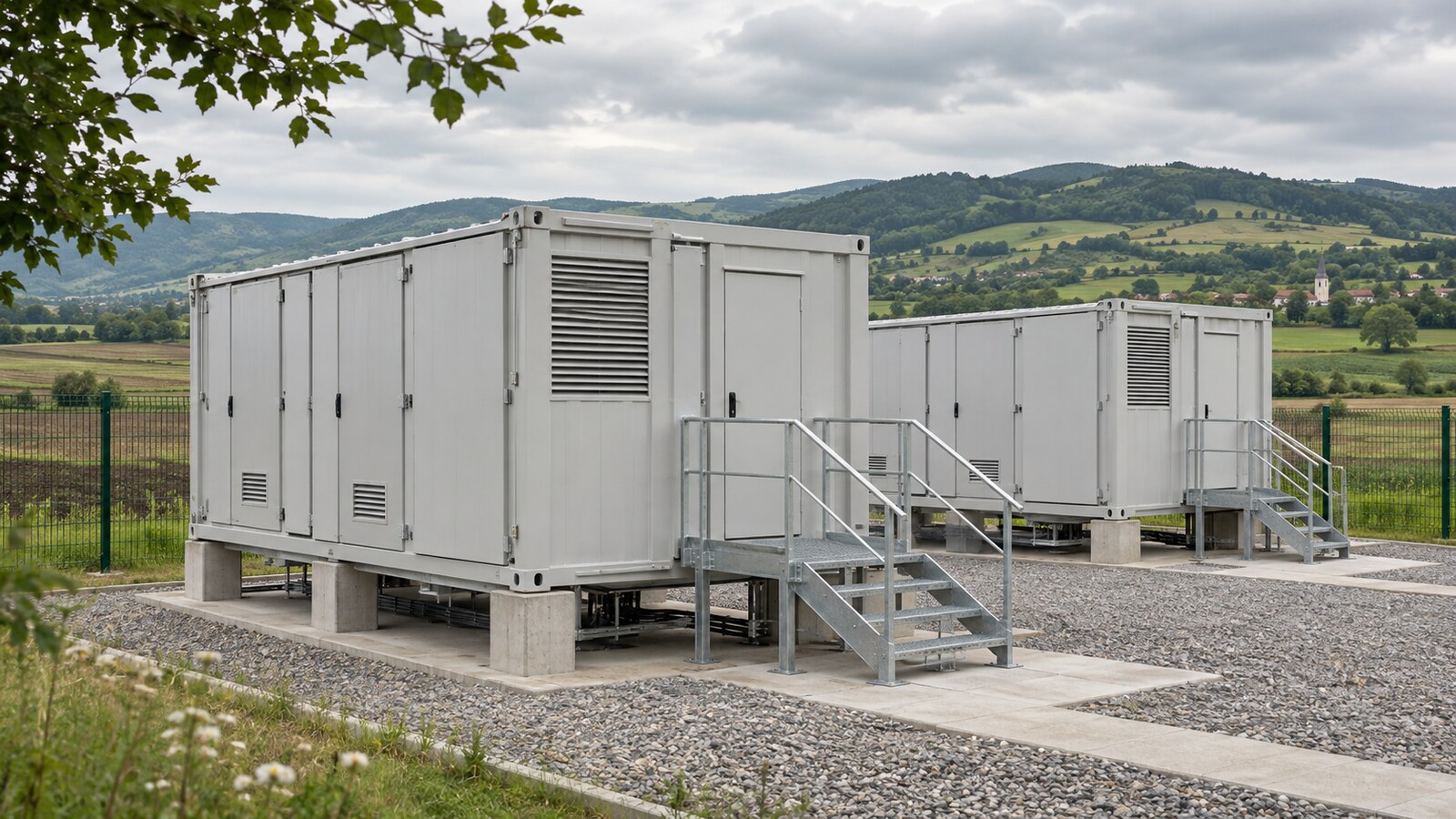
Should BESS containers be placed on continuous concrete platforms, or can developers achieve legal and commercial advantages by installing them on individual foundations, pillars or elevated steel structures?
Elevated configurations may reduce concrete works and the physical disturbance of the underlying land. However, a smaller foundation footprint does not automatically translate into a smaller legally recognised construction footprint, reduced agricultural land conversion obligations or lower permitting fees.
The distinction matters because different legal regimes may apply different definitions of land occupation.
For developers, the optimal solution requires an integrated assessment of construction classification, land rights, permitting costs, fire safety, taxation and project bankability.

1. Romania's new Construction Code: building or engineering structure?
On 25 August 2026, Romania's Law No. 169/2026 on the Spatial Planning, Urbanism and Construction Code (CATUC) entered into force, replacing, among other legislation, Law No. 50/1991 on construction permitting and Law No. 350/2001 on urban planning.
The new Code establishes a distinction that is particularly relevant for BESS projects.
Under Article 369(1) CATUC, constructions are classified as buildings, developments and engineering works.
Article 369(2) includes structures intended to house technological installations within the definition of buildings. However, Article 369(5) identifies energy infrastructure as a potential category of engineering works where the construction does not qualify as a building or development.
Furthermore, Article 326(3)(b) CATUC expressly includes energy infrastructure among engineering works subject to construction permitting.
This creates an important classification question for BESS facilities.
Battery containers, supporting structures, foundations, transformers, power conversion equipment and auxiliary facilities may not necessarily share the same legal classification.
Treating a BESS facility as energy infrastructure rather than an ordinary industrial building may be legally defensible depending on its technical characteristics. However, such classification must be properly supported in the permitting documentation.
Importantly, Article 327(2) CATUC provides for the corresponding application of building-permitting rules to engineering works unless otherwise provided by the Code.
Therefore, classification as engineering infrastructure should not be interpreted as an automatic exemption from urban planning requirements.
2. Construction footprint: the container projection or only the foundations?
Annex No. 1 to CATUC defines the land occupancy ratio (Procent de Ocupare a Terenului – POT) by reference to the built-up area of a building and the area of the relevant plot.
The definition refers to the ground projection of the construction's volume and, where applicable, permanent structural elements extending beyond its footprint at ground level.
Consider a battery container measuring 30 square metres, supported by four pillars occupying a combined area of only 2 square metres.
Where the installation qualifies as a construction whose area must be included in POT calculations, limiting the declared footprint to the supporting pillars would not automatically be justified. The projected area of the container may remain relevant.
Conversely, where the BESS installation is properly classified as engineering infrastructure or technological equipment, developers must separately assess whether and how POT applies under CATUC and the relevant local urban planning regulations.
Romanian legislation does not establish a general rule allowing all elevated BESS containers to be treated as occupying only the area of their foundations.
The applicable footprint must therefore be determined through legal classification and technical documentation rather than foundation geometry alone.
3. Agricultural land: a potentially significant optimisation opportunity
For projects developed on agricultural land outside built-up areas (extravilan), the more significant economic opportunity may concern the amount of land required to be removed from agricultural use.
Article 92(2)(j) of Land Fund Law No. 18/1991, as amended by Law No. 254/2022, expressly includes electricity storage units among the eligible renewable-energy-related investments that may be developed on certain categories of agricultural land, subject to statutory conditions and a maximum area of 50 hectares.
The relevant regime covers specified agricultural land in quality classes III, IV and V, subject to the required construction permits and agricultural land conversion approvals.
In addition, Article 92(4²) of Law No. 18/1991 provides for dual use of certain agricultural land categories, excluding arable land, combining agricultural activity with renewable electricity generation.
The implementing rules are particularly important.
Article 8²(1)–(3) of the procedure approved by Ministry of Agriculture Order No. 83/2018, as amended by Order No. 299/2022, regulates dual use for vineyard and orchard land.
Its definition of effectively occupied areas refers to structures constructed at ground level and expressly mentions mounting supports, inverters, transformer stations, electricity storage units, access roads and other technical components.
This framework may provide opportunities to preserve agricultural use across part of a project site while limiting the area formally removed from agricultural use.
However, two important qualifications apply.
First, the detailed dual-use procedure does not automatically extend to every agricultural land category.
Second, its application to a standalone BESS facility must be assessed separately, particularly where the project does not include an associated renewable electricity generation facility.
The possibility of reducing the converted area should therefore be treated as a project-specific legal question rather than an assumed entitlement.
The 31 December 2026 deadline
Article II of Law No. 254/2022 provides that the law's provisions produce legal effects until 31 December 2026.
As of 23 November 2026, Draft Law PL-x No. 469/2026, proposing an extension until 31 December 2028, had not completed the legislative process.
For investments relying on this special framework, the legal deadline and its implications for pending permitting procedures should be assessed before committing to a development timetable.
4. Construction permitting fees: what is the actual calculation basis?
Construction permitting fees are another area in which developers should distinguish between physical footprint and financial value.
Article 313(1) CATUC refers to Article 474 of the Romanian Fiscal Code.
Under Article 474(6) of Law No. 227/2015, the construction permit fee for non-residential and other qualifying constructions is generally 1% of the authorised value of construction works, including related installations.
Furthermore, Article 263(j) CATUC, read together with Article 327(2) for engineering works, refers to the estimated value of construction and installation works, excluding VAT, as reflected in the project cost estimate.
Accordingly, a reduction in the area of the foundations does not necessarily produce an equivalent reduction in permitting fees.
For BESS projects, developers should pay particular attention to distinguishing construction and installation works from the acquisition value of technological equipment.
The entire purchase price of battery equipment should not automatically be included in the permitting fee base, but its exclusion must be justified by the relevant project documents and cost breakdown.
Additional charges may include:
- Article 352(1) CATUC: a 0.5% contribution for construction quality oversight, subject to the applicable rules.
- Article 143(4) CATUC: a 0.1% contribution for state oversight of urban planning and construction permitting.
These charges have distinct calculation and payment rules and should be separately reflected in the development budget.
5. Tax classification and recurring operating costs
A BESS facility includes multiple asset categories that may have different tax and accounting treatments.
Battery containers, steel structures, foundations, transformers and electrical equipment should be analysed separately.
In particular, developers should assess whether certain components qualify as buildings for local tax purposes or should instead be classified as other constructions or technological installations.
Urban planning classification does not automatically determine tax classification.
Romania's Emergency Government Ordinance No. 89/2025 provides for the repeal of Title X of the Fiscal Code, concerning the tax on constructions, from fiscal year 2027.
Financial models should reflect the legislation currently in force while allowing for possible subsequent amendments.
A correct fixed-asset classification may have a more sustainable impact than attempting to achieve tax savings solely through structural design.
6. ANRE permits, grid connection and financial guarantees
BESS developments may require energy-sector authorisations in addition to construction permits.
Under Article 6 of the Regulation approved by ANRE Order No. 6/2025, establishment authorisations are required for independent or co-located electricity storage installations where the maximum electrical power exported to the grid exceeds 1 MW.
ANRE Order No. 16/2026 introduced Article 19¹, establishing a financial guarantee mechanism of EUR 30/kW for establishment authorisations falling within its scope.
Its precise applicability and calculation in respect of standalone BESS installations require separate verification, including the wording of the provision and the project's technical grid connection documentation.
Separately, ANRE Order No. 15/2026 amended grid connection regulations, including a 20% financial guarantee calculated on the grid connection tariff excluding VAT in specified circumstances.
These are distinct regulatory mechanisms.
Changes in the structural design or construction programme may therefore affect more than EPC costs. They may influence permitting milestones, financial security arrangements and the project's overall financing timetable.
7. Fire safety, environmental permitting and technical compliance
An elevated BESS configuration may reduce exposure to flooding or limit certain ground works, but it may also introduce additional engineering and operational challenges.
These include seismic resistance, fire service access, emergency response, thermal management, equipment replacement and long-term maintenance.
The applicable fire safety framework should be assessed in light of the project's specific technical characteristics, including the relevant technical regulations and Government Decision No. 571/2016.
Not every BESS configuration necessarily triggers the same formal fire safety approval requirements. These must be determined on a case-by-case basis.
Environmental permitting must likewise be considered under Law No. 292/2018 on environmental impact assessment, taking into account the nature and location of the development.
Developers should also verify whether the proposed installation is accepted under the battery supplier's warranties and the insurer's technical requirements.
A structurally innovative solution may ultimately become more expensive if it increases insurance costs, operational restrictions or replacement expenses.
8. Land rights and project bankability
Another critical distinction concerns the area physically occupied by foundations and the land rights required for the project.
Even where the supporting pillars occupy only a small surface, the developer may require rights over a significantly larger area for access, maintenance, underground cables, safety clearances, equipment replacement and emergency intervention.
Land ownership, superficies rights, easements and contractual access arrangements must therefore be structured to cover the operational requirements of the entire facility.
Insufficient land rights may complicate the creation or enforcement of lenders' security and affect the project's marketability.
From a financing perspective, properly secured access and operational control may be considerably more valuable than a marginal reduction in the nominal construction footprint.
9. Key legal questions before finalising a BESS design
Before selecting an elevated structure or a conventional installation platform, developers should consider:
- Whether the containers and associated components qualify as buildings, engineering works or technological installations.
- Whether POT applies and how the relevant footprint should be calculated under CATUC and local planning rules.
- The agricultural land category, quality class and applicable conversion procedure.
- Whether any dual-use agricultural regime can genuinely apply, particularly to standalone storage.
- The construction permit fee base and related statutory contributions.
- ANRE establishment authorisations, grid connection requirements and financial guarantees.
- Fire safety, environmental compliance, insurance and maintenance implications.
- Land tenure, lender security and long-term bankability.
Conclusion: legal optimisation goes beyond reducing concrete foundations
Elevated BESS containers may offer legitimate technical and commercial benefits.
However, reducing the physical area occupied by foundations should not be confused with automatically reducing the legally recognised construction footprint, agricultural land conversion obligations or permitting costs.
The relevant answer depends on the legal classification of the facility, the applicable land regime, the technical configuration and the overall investment structure.
The most attractive solution is therefore not necessarily the one requiring the least concrete, but the one that achieves the best combination of permitting certainty, capital efficiency, operational reliability and financing readiness.
How Grigorescu Partners supports BESS investments in Romania
Grigorescu Partners advises developers, investors and financing parties on the legal and regulatory aspects of energy infrastructure projects in Romania.
Our services cover project structuring, land rights and real estate arrangements, permitting and regulatory compliance, grid connection, development and EPC contracts, acquisitions, transactions and project financing.
For BESS developments, early legal assessment can help identify permitting constraints, avoid unnecessary costs and improve transaction and financing readiness.
Contact Grigorescu Partners to discuss the legal and regulatory structuring of your energy storage investment in Romania.
Principal legal references
- Law No. 169/2026 – Spatial Planning, Urbanism and Construction Code (CATUC): Articles 143, 263, 313, 326, 327, 352, 369 and Annex No. 1.
- Land Fund Law No. 18/1991: Article 92(2)(j) and Article 92(4²).
- Law No. 254/2022: Articles I and II.
- Ministry of Agriculture Order No. 83/2018, as amended by Order No. 299/2022: Article 8².
- Fiscal Code, Law No. 227/2015: Article 474(6) and (7).
- Regulation approved by ANRE Order No. 6/2025, as amended: Articles 6, 7, 10 and 19¹.
- ANRE Orders No. 15/2026 and No. 16/2026.
- Law No. 292/2018 on Environmental Impact Assessment.
- Draft Law PL-x No. 469/2026 – legislative status.
This article reflects the Romanian legislative framework reviewed as of 23 November 2026 and is provided for general information. The applicability of individual provisions must be assessed against the location, technical configuration and documentation of each project.